
Why I Pre-Ordered the Orb
I’m a user and customer experience professional and crypto, blockchain and AI Web3 developer based in St. Croix, U.S. Virgin Islands. I’ve been following how World (previously Worldcoin) seeks to change identity verification globally, as seen in my previous article “The Future of Digital Identity”.
Now I’m on the pre-order list for their hardware device, the Orb. My goal? To be among the first in the Caribbean—specifically in St. Croix—to use the Orb and document the full process: from shipping, customs, activation to local community implications.
Maybe a failure, but definitely a statement. For a small island economy and a tightly-connected community, being a first adopter in emerging identity tech can have a big impact on the tech ecosystem and services. And with the Orb, I can become a Community Operator and earn Worldcoin (WLD) by verifying others identities. Did I say there are a lot of tourists, from different places, in St. Croix?
And at the moment, the USS Iwo Jima, part of the U.S. Southern Command’s fleet, returned to Frederiksted pier for the second time in just over a month, bringing 3700 prime-aged personnel to the island.
What the Orb Is & Why It’s Under the Spotlight
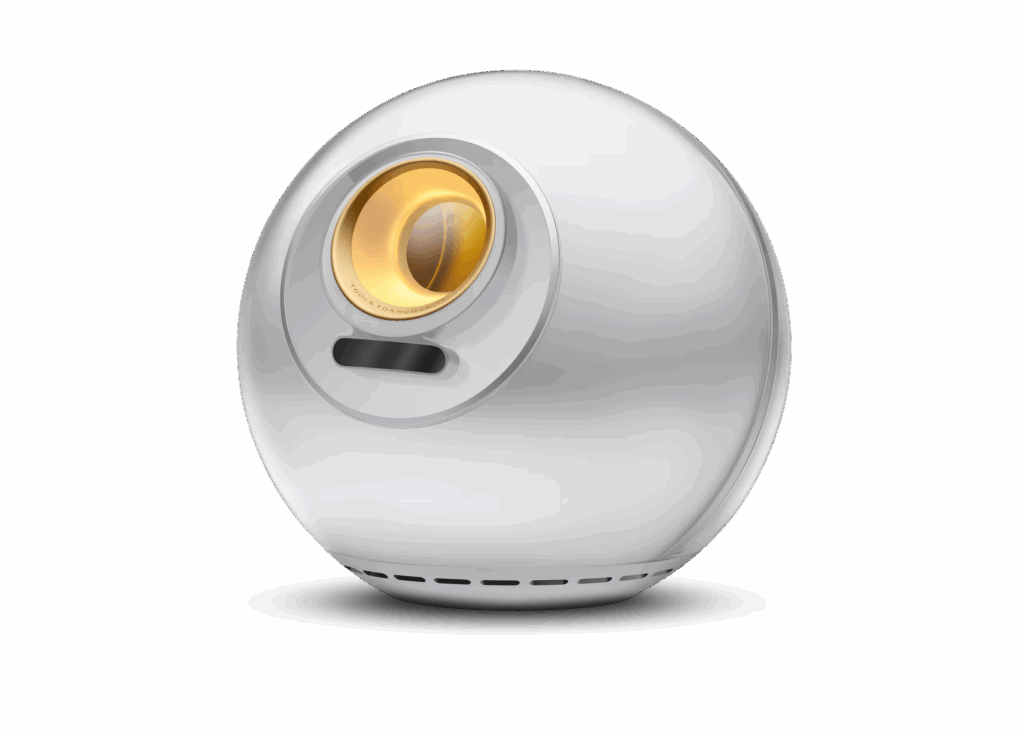
The device known as the Orb was developed by the company Tools for Humanity (TFH) to verify human identity. It uses iris scans (and face/eye imaging) to generate a “proof of personhood” known as the World ID. It aims to provide global, equitable access to Worldcoin via the World ID protocol and involves both hardware and software (custom optics, imaging, software stack) and is open-source. A former Apple designer named Thomas Meyerhoff contributed to its design.
The device takes pictures of your face and eyes, encrypts the data, and aims to only store a hashed version of your iris code rather than a full image. World says the Orb is designed to prevent duplicate registrations, as each human should register only once. The project is explicitly tied into a vision of verifying humans in an age of AI.
So if you’re thinking: “What’s the value?” — it’s about early-adoption claim, digital identity credentials, potential tie-ins with future applications (finance, social, governance) and being ahead of the curve.
But most importantly, the number one reason is protecting yourself. We’re already at the point with AI where your likeness can copied near perfectly. This is your signature in the age of AI.
My Pre-Order Experience (What I’ve Done So Far)
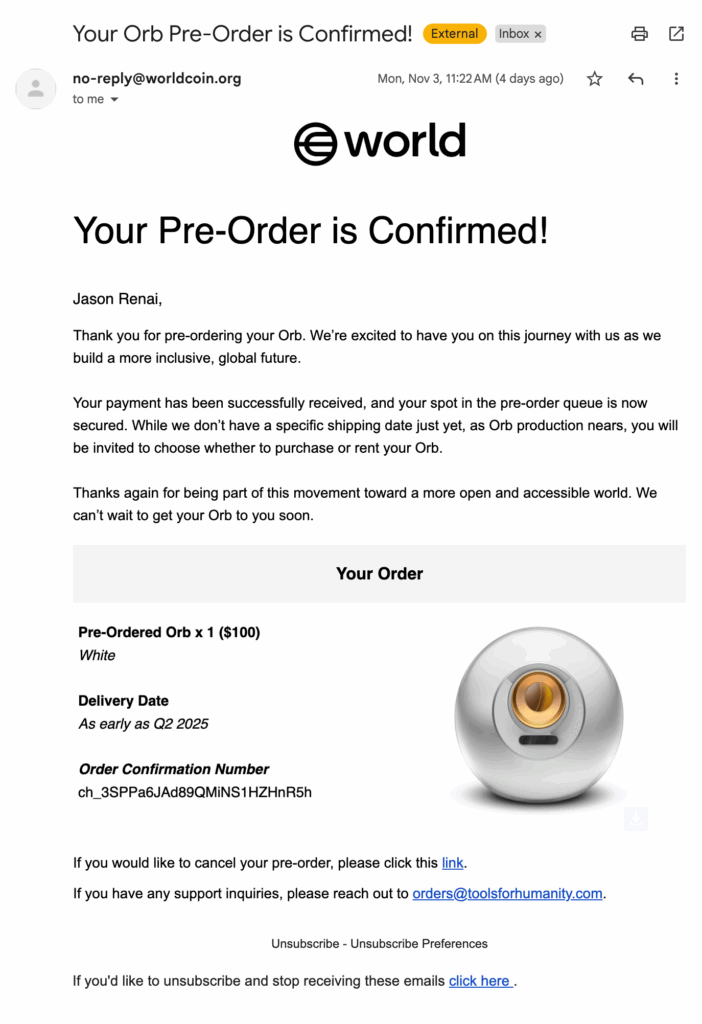
I joined the pre-order list for the Orb device—locking in priority for delivery when shipping begins. I paid with Amazon pay because Amazon will ship to my location, with a fee.
As you can see, the receipt says the Orb ships “as early as Q2 2025” so they’re obviously behind but the website still says Orbs are in production and are estimated to start shipping October 2025. I’m documenting logistics: shipping to St. Croix, import/customs in USVI, local verification infrastructure (internet, power, place to set up). As of October 2025, I’m running Starlink.
I’m preparing to test the full user journey: from scanning the device, to activating World ID, to how this integrates with my existing work (UX/AI/web dev) and local brand/community in the Virgin Islands.
I’ll document cost, wait-time, hardware experience, local community reaction, any roadblocks.
Local Relevance: Why This Matters for St. Croix & the Caribbean
For small islands like St. Croix, remote communities, diaspora links, tourism flows, digital identity has outsized importance. A hardware device landing here first means we’re not always playing catch-up. Putting St. Croix in connection with this cutting-edge tech helps shape the local narrative on innovation—technology entrepreneur in the Caribbean ready to adopt globally significant devices.
I’ll test real-world issues including shipping/fees for USVI, local internet/venue for scanning, tourist readiness and community comfort with biometric devices in a Caribbean cultural context. If verification is seen as valuable, there may be local opportunities (events, tourism, government services) to leverage the technology.
But as a U.S. territory, the US Virgin Islands comes under U.S. and local jurisdiction. Biometric data export/import, customs, risk, regulation — all need scrutiny. I’ll cover these gaps so readers get an honest view.
Benefits vs Risks (And What to Watch Out For)
Benefits
- Early-adopter status gives you a story, first-mover advantage.
- You’ll gain hands-on understanding of an identity hardware device in your region.
- Potential future leverage (developing local service, being “community operator”, being known as the first Caribbean installer).
Risks / What to scrutinize
- Shipping and delivery uncertainty: timelines often shift (see reports).
WIRED - Regulatory / privacy concerns: biometric data is ultra-sensitive — projects like this have been flagged by data-privacy authorities globally (e.g., in Hong Kong, Spain).
Reuters - Local fit: The device may require certain infrastructure or venue that might not map neatly to St. Croix (power stability, internet bandwidth, customs).
- Community uptake: Will locals be comfortable scanning their irises? Will awareness/trust be there? What about visiting tourists?
- Token / economic upside: If you’re expecting crypto rewards, there may be geographic restrictions or economic fluctuations.
- Privacy & security: Although the Orb claims to store only hashed codes, you must understand what data is kept, who controls it, what rights you have.
Is Orb available in the the Territory?
I’m pre-ordering the Orb, but at the moment deployment in St. Croix / USVI is unconfirmed. This could be the pioneer claim—but also the risk/unknown failure. Currently, the website says WLD is not available for distribution in the State of New York or other restricted territories.
Yes, WLD token can be accessed in the US Virgin Islands via at least one exchange. But I can’t assume full access to all features (verification via Orb, token-grant claims, “being first” status) without further verification. I need to:
- Check which platforms I can personally trade or claim WLD from in St. Croix.
- Confirm whether the Orb verification is eligible in USVI or if there are geographic restrictions.
So as of 2025 the token is tradable in USVI, but verification/hardware rollout remains unconfirmed for the territory.
What I’ll Document and Seek to Learn
- Timeline: When I receive the device, when it’s activated, when full verification is complete.
- Cost & Logistics: Shipping cost to St. Croix, duties/customs if any, local setup cost.
- User Experience: How intuitive is the scan? How long does it take? What environment is required? How’s the UI/UX?
- Local Community Reaction: When I share this with peers/tech community in USVI — their questions, concerns, excitement. What will non-tech locals think of scanning their biometrics and identities?
- Regulation & Data Rights: What disclosure did I get? What are my rights to withdraw my data? What are the local regulation implications for biometrics in USVI?
- Value Proposition: Did it deliver something tangible (access to a network, token allocation, service capability) or was it mainly a tech experiment?
- Integration: Can I tie this device into my other work or products I’m developing?
Conclusion & What’s Next
I’m not just here for the hype. Pre-ordering of the Orb is a calculated move—to test in real terms the intersection of advanced identity tech, Caribbean infrastructure, local culture, and technological innovation. And to be clear, a strategic investment my, your and our future.
I’ll publish follow-ups along the way. Stay tuned to travel to the future of identity.








You must be logged in to post a comment.